|
| A simple breakdown of why money disappears each month and how a structured system helps you save and grow. |
You work hard. The income is decent. But somehow, every single month ends the same way — the account is running low, the paycheck feels like it disappeared, and you have almost nothing to show for it.
If this sounds familiar, you are not alone.
You don’t have an income problem — you have a system problem.
And that’s actually good news, because systems can be fixed.
Why Am I Always Broke Even with a Good Income?
If you have no money left at the end of the month, even with a good income, the issue is not how much you earn — it’s how your money is managed.
Without a structured system:
- Spending increases with income
- Savings become optional
- Money disappears without control
This is why so many people with a good income, but no savings feel stuck financially.
Why You Have No Money Left at the End of the Month (Even with a Good Income)
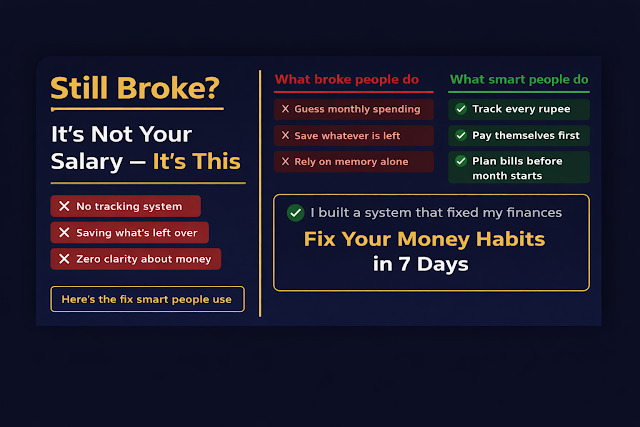
You Don’t Track Where Your Money Goes
If you cannot clearly explain where your money went this month, your money is leaking.
People who track spending consistently save significantly more than those who don’t. Untracked money always gets spent — just not intentionally.
Lifestyle Inflation Is Eating Your Income
As your income grows, your lifestyle grows with it.
Better food. More subscriptions. Bigger expenses.
This silent upgrade is why people earning more still end up with no money left at the end of the month.
You Spend First and Save What’s Left
Saving after spending doesn’t work.
If you wait until the end of the month to save, there will usually be nothing left.
You must flip the system:
👉 Save first, spend later.
Hidden Expenses Are Draining You
Subscriptions, renewals, small charges — they add up.
Most people underestimate how much they spend monthly on these by a large margin.
Why People With a Good Income Still Have No Savings
Assuming High Income Equals Stability
Income is not stability.
What you keep matters more than what you earn.
No Financial System in Place
Without a system:
- Decisions are emotional
- Spending is reactive
- Results are inconsistent
A system removes guesswork and creates structure.
How to Stop Running Out of Money Every Month (Proven System)
You don’t need complex tools. You need 3 simple systems.
Step 1 — Create a Monthly Allocation Plan
Use the 50/30/20 rule:
- 50% → Needs
- 30% → Wants
- 20% → Savings & Goals
👉 Most important rule:
Save first, automatically.
Step 2 — Track Every Dollar Weekly
Spend 10 minutes weekly reviewing:
- Where money went
- If you stayed within limits
- If savings happened
This small habit creates massive control.
Step 3 — Build a Financial Control System
Track monthly:
- Net worth
- Savings
- Debt
- Cash flow
- Financial goals
👉 What gets tracked improves.
Real Example: How to Manage Money So You Don’t Run Out Monthly
Income: $3,500/month
- Needs → $1,750
- Wants → $1,050
- Savings → $700
This system builds:
- Emergency fund
- Debt reduction
- Investment habit
All without increasing income.
How to Stay Consistent with Your Money (Without Feeling Broke)
Automate Your Finances
Remove decision-making.
Set Clear Financial Goals
Specific goals = better results.
Reduce Impulse Spending
Use the 48-hour rule before purchases.
Final Thoughts: You Don’t Need More Money
The biggest mistake people make:
👉 Thinking more income will fix everything
It won’t.
Without a system, more money just disappears faster.
You don’t need more money. You need control.
Frequently Asked Questions
Why do I have no money left at the end of the month?
Because of untracked spending, lifestyle inflation, and lack of a financial system.
How much should I save each month?
Start with 20%. If not possible, start smaller and increase gradually.
What is the best budgeting method?
The 50/30/20 rule is the simplest and most effective for most people.
Take Control of Your Money
Stop guessing. Start using a system that works.
👉Take the free NLF audit and get your NLF Score Free, no sign-in required. An educational self-assessment, not a credit rating.
Disclaimer:
The information on this website is for educational purposes only and should not be considered financial or investment advice. We are not responsible for any decisions made based on this content.