|
|
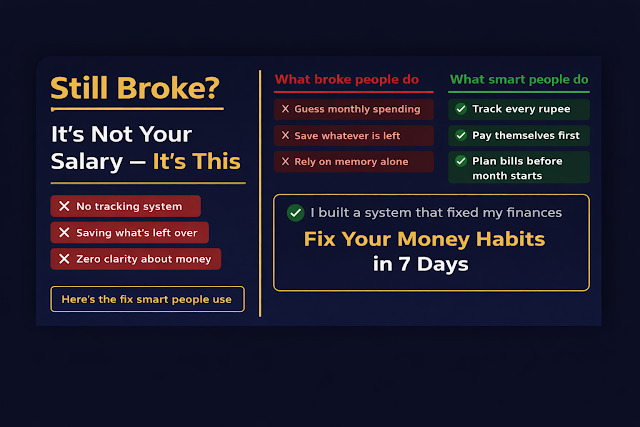
A simple 3-step money management system: learn how money works, track your monthly income and expenses, and monitor your net worth, goals, and debt to build long-term financial stability. |
The problem, laid out honestly
For roughly three years I earned a consistent take-home of $3,400 per month. Not rich. Not struggling on paper. But here is what every single month actually looked like:
| Category | Amount | What remained |
|---|---|---|
| Take-home income | $3,400 | $3,400 |
| Rent | $1,100 | $2,300 |
| Groceries, transport, utilities, phone | $680 | $1,620 |
| Dining, entertainment, impulse purchases | $1,460 (untracked) | $160 |
| Left by the 20th | $160 — for 10 days | |
I was not spending dramatically on anything. No designer clothes, no expensive holidays. The money just evaporated — because it had no instructions.
Change one: I looked at what my debt was really costing me
I carried a $3,800 credit card balance at 28% annual interest. I knew debt was bad. I did not know what that actually meant in numbers until I ran the calculation.
Interest paid
“That one informed decision — redirecting $200 from wants to my credit card — saved me $4,160 in interest.”
Change two: I gave every dollar a job before the month started
The 50/30/20 rule is not new. But running it as a pre-committed allocation — before the month begins, not after — is what made it actually work. Here is exactly how $3,400 split out:
$1,700
$1,020
$680
The $680 goals transfer moved automatically on payday — before touching anything else.
The difference was not income. It was that the money had instructions it could not ignore.
Change three: I tracked net worth every single month
Month one, my net worth was negative $5,400. I owed more than I owned. I wrote the number down, dated it, and committed to recalculating it on the 1st of every month without exception.
Zero line (breakeven)
Illustrative example — one person’s actual figures, not a guaranteed outcome. Your own results will differ.
| Month | Net Worth | Change | Status |
|---|---|---|---|
| Month 1 | -$5,400 | — | Starting point |
| Month 3 | -$3,850 | +$1,550 | Negative |
| Month 6 | -$1,920 | +$1,930 | Negative |
| Month 9 | -$390 | +$1,530 | Almost zero |
| Month 11 | +$1,240 | +$1,630 | Positive |
| Month 14 | +$4,800 | +$3,560 | Building net worth |
Total debt
The five numbers I tracked every month
| Metric | Start | Month 14 | Why it matters |
|---|---|---|---|
| Net worth | -$5,400 | +$4,800 | Your real financial score |
| Total savings | $0 | $6,200 | Visible goal progress |
| Total debt | $9,200 | $0 | Shrinking = momentum |
| Monthly cash flow | -$120 | +$680 | Is the system working? |
| Emergency fund % | 0% | 100% | End of 2am anxiety |
What this actually took — honestly
No dramatic lifestyle overhaul. No second job. No cutting all enjoyment from life.
“The people who stay anxious about money indefinitely are not lazier. They simply never got the structure in place that lets the system carry the weight instead of their willpower.”
Three changes. That is the whole story.
| # | Change | Key action | Result |
|---|---|---|---|
| 1 | Financial knowledge | Calculated real debt cost | Saved $4,160 in interest |
| 2 | Monthly allocation | Automated the 20% transfer | $7,800 saved in 12 months |
| 3 | Monthly tracking | Net worth + 4 metrics | -$5,400 to +$4,800 in 14 months |
I wish someone had handed me this system earlier — it would’ve saved me years of stress.
If you want that same clarity for your own numbers, the free NLF audit is the quickest way to get it.
Take the free NLF audit Free, no sign-in required. An educational self-assessment, not a credit rating.
Next Level Finstra is an educational platform. Content is for informational purposes only and does not constitute financial advice. Results described reflect one individual’s experience and may vary.