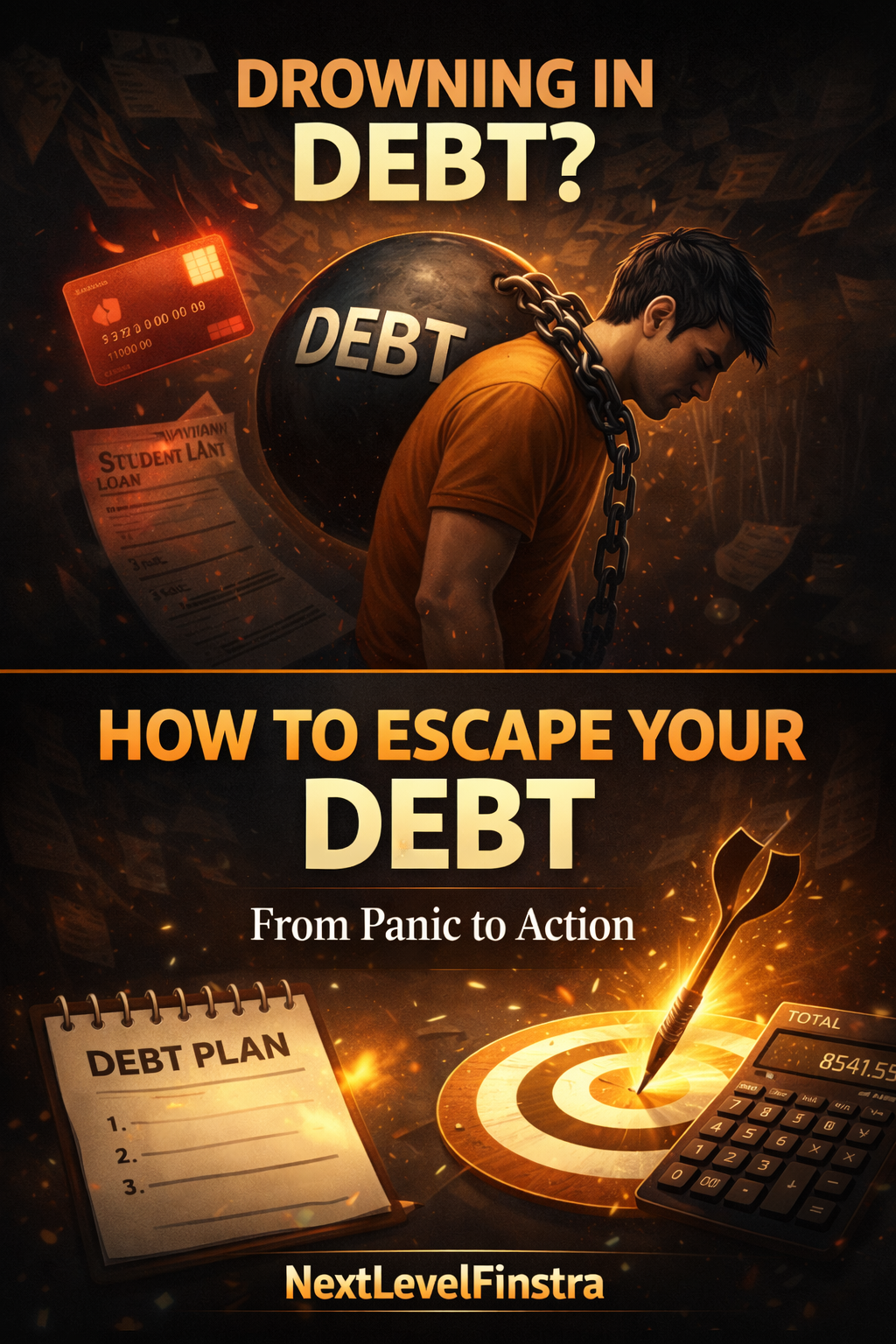
Debt feels like a weight around your neck that never quite lifts.
Whether it’s a credit card balance that seems to grow no matter how much you pay, a student loan that’s followed you for years longer than you expected, or a personal loan you took out during a moment of crisis — the combination of compound interest, minimum payments, and mounting anxiety creates a feeling that is almost impossible to shake.
You’re running on a treadmill. Moving fast, sweating hard, going absolutely nowhere.
Here’s what nobody tells you early enough: debt is not just a math problem. It’s a psychological one. The numbers matter, yes — but the reason most people stay in debt for years longer than necessary isn’t because they don’t earn enough. It’s because they don’t have a system. They make payments reactively, avoid opening their bank statements, and hope that somehow, someday, the balance will just disappear.
It won’t. Not without a plan.
This guide is that plan. We’re going to walk through exactly how to face your debt head-on, choose the right repayment strategy for your personality, and speed up the process so you can stop paying interest to banks and start building net worth for yourself. This is your roadmap from panic to action — and it starts right now.
Step 1: Face the Numbers (The Audit Phase)
You cannot defeat an enemy you haven’t identified.
This is the step most people skip — or delay for months, sometimes years — because opening the statements and adding up the totals feels genuinely terrifying. The anxiety is real. But here’s the thing about financial avoidance: it doesn’t make the debt smaller. It makes it grow. Every month you look away, the interest compounds quietly in the background, and the mountain gets a little steeper.
The single most powerful thing you can do today — before choosing a repayment method, before cutting your budget, before anything else — is to create a complete Debt Inventory.
Open a spreadsheet, grab a notebook, or use whatever tool you’re comfortable with. Create four columns and fill them in for every single debt you owe:
- The name of the debt — Visa Card, Student Loan, Car Loan, Personal Loan, whatever it is.
- The total balance owed — the full outstanding amount, not just last month’s statement.
- The interest rate (APR) — this is the number that determines how expensive each debt is.
- The minimum monthly payment — the floor you’re already committed to every month.
Add everything up. Look at the total. Breathe.

That number — however large it feels — is no longer a monster under the bed. It’s a maths problem on a page. And maths problems have solutions. Once you can see exactly what you’re dealing with, you move from a state of vague, shapeless dread into a state of specific, solvable clarity. That shift alone changes everything.
Step 2: Choose Your Weapon — Debt Snowball vs. Debt Avalanche
Once you have your Debt Inventory in front of you, it’s time to choose your repayment strategy. There are two primary methods used by personal finance experts worldwide, and the ongoing debate about which is “better” misses the point entirely.
The best debt repayment strategy is the one you will actually stick to.
Here’s how each one works.
Method A: The Debt Snowball (The Psychological Win)
The Debt Snowball method, popularized by financial author Dave Ramsey, is built on a simple insight: motivation matters more than mathematics when it comes to behavior change.
How it works: List your debts from smallest balance to largest. Pay the minimum on every debt — except the smallest one. Every extra dollar you can find goes toward eliminating that smallest balance as fast as possible. Once it’s gone, you take the full payment you were making on that debt and add it to the next smallest. The payment grows — like a snowball rolling downhill — as each debt disappears.
The result: You pay off individual debts faster than you ever have before. Each eliminated balance is a genuine win — a moment of real, tangible progress that fuels your motivation to keep going. That psychological momentum is not a small thing. It’s the engine that keeps people going through a multi-year debt repayment when the alternative is giving up.
Mathematically: The Snowball is not the cheapest method. Because you’re ignoring interest rates, you may end up paying more in total interest over time compared to the Avalanche.
Best for: People who have struggled to stay motivated with debt repayment in the past, those who need visible wins to maintain momentum, and anyone who finds the emotional weight of debt heavier than the financial weight.
Method B: The Debt Avalanche (The Mathematical Win)
The Debt Avalanche method is the approach a mathematician would design. It ignores psychology and optimizes purely for cost efficiency.
How it works: List your debts from highest interest rate (APR) to lowest. Pay the minimum on every debt — except the one with the highest interest rate. Every extra dollar attacks that high-APR balance first. Once it’s eliminated, you roll that full payment into the next highest-rate debt.
The result: Because you’re targeting the most expensive debt first, you pay significantly less total interest over the life of your repayment plan. In many cases, the Avalanche will get you debt-free weeks or even months earlier than the Snowball, while saving you hundreds or thousands of dollars in interest charges.
Mathematically: The Avalanche wins on paper, every time.
The catch: The first debt you’re targeting might be your largest balance, which means it could take a very long time before you see a debt fully disappear. For people who need quick wins to stay motivated, this waiting period can be psychologically brutal — and causes many people to abandon the plan entirely.
Best for: Disciplined, data-driven people who find motivation in knowing they’re taking the most efficient route, and who can stay the course without needing early wins.
Snowball vs. Avalanche: Which Should You Choose?
Here’s the honest answer: it depends on who you are, not what the math’s says.
If you’ve tried and abandoned debt repayment plans before, choose the Snowball. The quick wins will keep you in the game long enough for the system to work.
If you’re motivated by efficiency, optimization, and total cost savings — and you have the discipline to stay focused without seeing early results — choose the Avalanche.
Either method, executed consistently, will get you out of debt. A perfect plan abandoned after three months is worth nothing. An imperfect plan followed for three years will change your financial life.
Step 3: How to Speed Up the Process (The “Fast” Part)
If you want to get out of debt fast, minimum payments won’t cut it. The real acceleration comes from attacking the principal from two directions simultaneously: reducing what goes out and increasing what comes in.
Negotiate your interest rates. This is the most underused tool in debt management. Call your credit card companies directly. Tell them you’re exploring debt consolidation options and ask whether they can lower your APR. Many will — especially if you have a history of on-time payments. A reduction of even two to three percentage points can save you hundreds of dollars in interest and shave months off your repayment timeline. The call takes ten minutes. It costs nothing. Make it.
Go on a temporary “war footing” budget. For a defined period — three to six months — cut every non-essential expense with no exceptions. This is not a permanent lifestyle. It’s a short, intense sprint designed to generate as much extra cash as possible to throw at your debt. Subscriptions, dining out, impulse purchases — all of it pauses temporarily. The discomfort is real, but so is the result.
Direct every side hustle dollar to debt. If you pick up freelance work, sell things you don’t need, or take on extra hours, that income has one job and one job only: eliminating debt principal. This is critical. The biggest risk of earning extra money is that it quietly disappears into slightly nicer groceries and one-click Amazon purchases. It’s called lifestyle creep, and it is the silent killer of every debt repayment plan. Every extra dollar earned must have a destination the moment it arrives.
Stop creating new debt. This sounds obvious, but it needs to be said clearly. You cannot fill a bucket while it has a hole in the bottom. If you’re paying down a credit card during the week and charging it again on weekends, your progress will be so slow it’ll feel invisible. For the duration of your repayment plan, the cards go in a drawer. You use what you have.
The Path to Freedom
When the debt is gone, something remarkable happens. The money that was flowing out every month in minimum payments and interest charges — dead money, money that built nothing and earned you nothing — suddenly stays with you. And that money, redirected into investments, savings, and income-producing investments, begins working for your future instead of servicing your past.
The cycle breaks the moment you decide it does. And it breaks not with luck, but with a system.
Don’t fight the debt battle without a clear scoreboard.
To execute the Snowball or Avalanche method effectively, you need total clarity on your numbers at every stage — how much you owe, how much you’re saving in interest, and exactly how many months stand between you and debt freedom.
The Financial Clarity Operating System includes a dedicated Debt Repayment module that runs both the Snowball and Avalanche calculations for your exact debts — so you can see the difference, choose your strategy, and track your progress month by month.
👉 [Take the free NLF audit and see where your debt actually stands] Free, no sign-in required. An educational self-assessment, not a credit rating.