The “9-to-5” is a great foundation. It pays the bills, builds your résumé, and gives you a sense of structure. But here’s the uncomfortable truth that most financial advisors won’t say out loud: a salary has a ceiling.
There are only 24 hours in a day. Once you’ve filled them with work, commuting, eating, and sleeping, you’ve hit your limit. No matter how hard you grind, how many overtime hours you clock, or how aggressively you negotiate your next raise, active income — trading your time for money — will always be capped by the number of hours you’re physically able to give.
Income from assets breaks that ceiling.
Asset income is money that comes in whether you’re at your desk, on a beach, or fast asleep. It’s the concept behind every high-net-worth portfolio — from the landlord collecting rent checks to the author earning royalties on a book they wrote a decade ago. And before you tell yourself it’s only for people with deep pockets, here’s what most people get wrong: you don’t need thousands of dollars to start. You need a plan, a little patience, and in many cases, just $100.
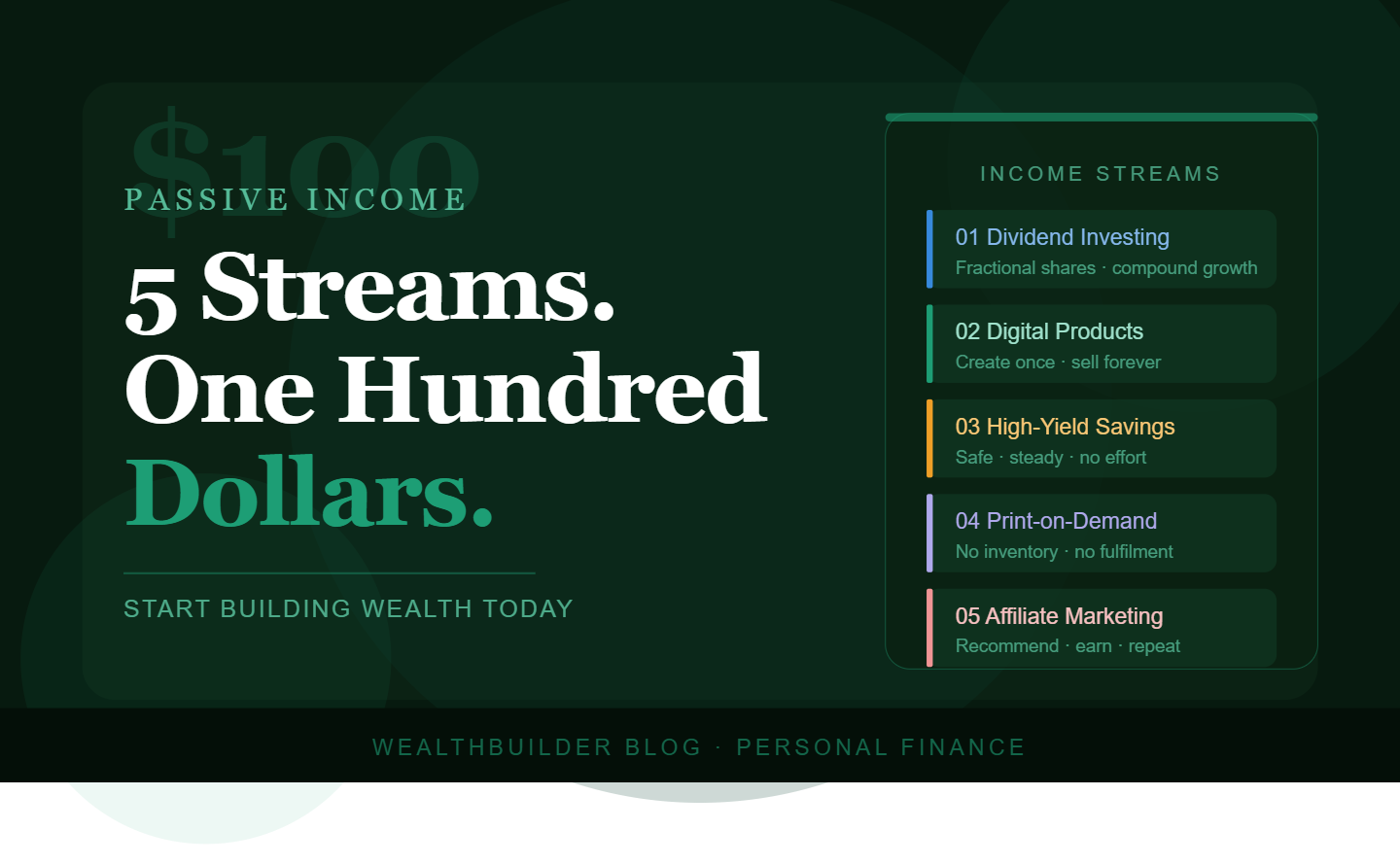
Here are five legitimate income streams — the kind that earn from an asset rather than from your hours — that you can launch with a hundred bucks.
1. Fractional Dividend Investing
Let’s kill a myth right away: you don’t need to buy a full share of Apple, Coca-Cola, or Johnson & Johnson to become an investor. Thanks to fractional share investing, you can own a slice of a company’s stock — even if a single share costs $180 or $500.
Apps like Robinhood, Charles Schwab, and Fidelity all offer fractional share investing with no minimum deposit. With your $100, you can build a mini-portfolio of dividend-paying stocks spread across several companies rather than betting everything on one.
So what’s a dividend? When a company is profitable, it sometimes distributes a portion of those profits back to shareholders — that’s a dividend. You earn it simply for owning the stock. You didn’t have to work for it, attend a meeting, or do anything other than hold the shares. Some of the most reliable dividend payers — companies like Realty Income, Procter & Gamble, and Coca-Cola — have paid and grown their dividends for decades without interruption.
Now, on $100 your dividend income will be modest at first. That’s completely expected. The power here is not the first payment — it’s reinvestment. Every dividend you receive gets ploughed back into buying more shares, which then generate more dividends, which buy more shares. This is compound growth, and given enough time, it genuinely behaves like a snowball rolling downhill.
Start small, stay consistent, and let time do the heavy lifting. A $100 starting investment with regular contributions builds meaningful income from assets over five to ten years — not overnight, but very real.
Best for: People who want to invest in proven companies and don’t mind a slow, steady build.
Your $100 goes toward: Opening your brokerage account and your first fractional share purchases.
2. Digital Products (The Scalable Model)
Here’s the most exciting thing about digital products: you create them once and sell them forever. There is no inventory. No shipping. No warehouse. No restocking. Every sale after the first one is almost pure margin.
The question is: what do you know that other people would pay to learn?
You don’t need to be a world-class expert. You just need to be a few steps ahead of someone else. If you know how to organise a chaotic household, that’s a digital planner waiting to be made. If you’ve mastered meal prepping for a family of four, that’s a recipe template pack. If you understand Excel formulas, budgeting structures, or content calendars, those are all sellable products.
Your $100 budget gets you a lot here. A Canva Pro subscription runs around $13 per month and gives you access to professional design templates, fonts, and tools to build polished PDFs, printables, and slide decks. A basic domain name costs around $10 to $15 per year. The rest can cover a listing on Etsy (which charges just $0.20 per listing) or a free shop on Gumroad, where you only pay a small fee when you make a sale.
The product itself doesn’t need to be long or complicated. A five-page budgeting checklist, a weekly meal plan template, or a “how to start freelancing” guide can sell for $5 to $25 a pop. Sell 20 copies a month and you’ve created a quiet, automated revenue stream that runs in the background of your life.
Best for: People with a teachable skill or knowledge base who want maximum scalability.
Your $100 goes toward: Canva Pro, a domain name, and your first product listing fees.
3. High-Yield Savings Accounts (HYSA)
This one isn’t glamorous. It won’t go viral on TikTok. But it is genuinely one of the smartest things you can do with money right now — especially if your savings are sitting in a traditional bank account earning next to nothing.
Most big-name banks offer savings account interest rates so low they’re practically decorative. We’re talking 0.01% to 0.05% annually. On $100, that’s less than a nickel per year. Your money is technically growing, but at a rate slower than inflation, meaning it’s actually losing purchasing power in real terms.
High-Yield Savings Accounts (HYSAs), offered by online banks like Marcus by Goldman Sachs, Ally, and SoFi, operate differently. They offer significantly higher interest rates — often 10 to 20 times more than traditional banks — because their lower overhead costs (no physical branches) allow them to pass those savings on to you as interest.
Your money is still FDIC insured, still accessible, and still perfectly safe. You’re not taking on any risk. You’re simply moving your dollars to an account that actually rewards you for having them there.
On $100 this won’t make you rich. But every income stream starts somewhere, and building the habit of putting your money in the highest-yielding safe account available is a fundamental net-worth-building behaviour that pays off increasingly as your balance grows.
Best for: Anyone who hasn’t already set this up — this should be the first move for every dollar you’re not actively investing.
Your $100 goes toward: Your opening deposit into a high-yield savings account.
4. Print-on-Demand (POD)
Print-on-demand is one of the most genuinely low-barrier asset-income models available today, and it’s dramatically underused by people outside the design community.
Here’s how it works: you upload a design to a platform like Printful, Printify, or Redbubble. That design gets placed on products — t-shirts, mugs, tote bags, phone cases, wall art. When a customer buys a product featuring your design, the platform handles everything: printing, packaging, shipping, and customer service. You collect a percentage of the sale price. You never see the physical product. You never hold inventory. You never pack a single box.
Your $100 investment covers a few things: potentially a Canva Pro subscription to create clean designs, a small amount to order sample products (so you can verify quality before selling), and in some cases a modest amount to run a short test ad to drive traffic to your shop.
The designs that sell best are not necessarily the most artistic. Clever phrases, niche community humour, minimalist typography, and designs that speak to specific identities (“dog mum,” “nurse life,” “plant parent”) consistently outperform generic art. You don’t need to be a graphic designer — you need to understand your niche.
The key to POD success is volume and patience. Build a library of 20, 30, 50 designs across multiple niches, list them across multiple platforms, and let the algorithm work in your favour over months, not weeks.
Best for: Creative people, niche community members, or anyone willing to research what’s selling.
Your $100 goes toward: Design tools, sample product testing, and initial platform setup.
5. Affiliate Marketing via Niche Content
Affiliate marketing has a bad reputation in some corners of the internet because of the spammy, dishonest way some people have used it. Done right, however, it’s one of the most powerful and scalable asset-income models in existence — and the barrier to entry is incredibly low.
The concept is simple: you recommend a product or service that you genuinely use and believe in. Someone clicks your unique affiliate link and makes a purchase. You earn a commission — typically between 5% and 30% of the sale price — without any inventory, fulfilment, or customer service on your end.
Your $100 is enough to get started properly. A basic WordPress website through a host like Hostinger or Bluehost costs around $3 to $5 per month, leaving you with money to spare for a domain name and a simple theme. From there, you start creating content — blog posts, product comparisons, tutorials, or reviews — focused tightly on a specific niche.
The niche matters enormously. “Fitness” is too broad. “Home workouts for people over 50” is a niche. “Hiking gear for beginners” is a niche. “Budgeting tools for freelancers” is a niche. The tighter your focus, the more relevant your audience, and the higher your conversion rate on affiliate links.
Programmes like Amazon Associates, ShareASale, and individual brand affiliate programmes are free to join and offer commissions on thousands of products. One well-ranking blog post recommending three or four products can generate passive commissions for years without you touching it again.
Best for: Writers, content creators, and people who are passionate about a specific topic.
Your $100 goes toward: Web hosting, a domain name, and your first few months of content creation.
The Golden Rule of Asset Income
Before you dive in, there’s one thing you need to understand clearly — because the word “passive” is genuinely misleading for beginners.
This kind of income is not free money. It is not a shortcut. It is not a scheme.
What it actually is: front-loaded effort. Every one of the five streams above requires real work upfront — researching dividend stocks, creating digital products, designing POD graphics, writing affiliate content. That work is real, and it takes time. The “passive” part comes later, once the systems are built and running.
Think of it like planting a tree. You do the work of planting and watering in the beginning. A year from now, the tree grows whether you’re tending to it or not. Five years from now, it’s providing shade and fruit without you lifting a finger. That’s asset income done properly.
Start one stream. Build it with genuine effort. Once it’s producing steady income, add a second. Diversify gradually. The goal is not to launch five income streams at once — it’s to build one that works, learn from it, and stack the next one on top.
Final Thought: The Real Goal Is Options
Every dollar of asset income you build buys you something more valuable than money — it buys you options. The option to leave a job that drains you. The option to take a month off without financial panic. The option to say yes to an opportunity without doing the mental maths first.
That’s what $100, invested wisely and consistently, can grow into. Not overnight. But more quickly than most people expect when they finally start.
Making money is only half the battle. The other half is keeping it.
As your asset income grows, your finances will get more complex — multiple income streams, investments to monitor, a net worth that’s actually worth tracking. Don’t let your new profits disappear into mindless spending just because you don’t have a clear picture of where everything stands.
The Financial Clarity Operating System tracks every dollar, monitors your investments, and shows your net worth growing in real time — all in one place.
👉 [Take the free NLF audit and see where you actually stand] Free, no sign-in required. An educational self-assessment, not a credit rating.